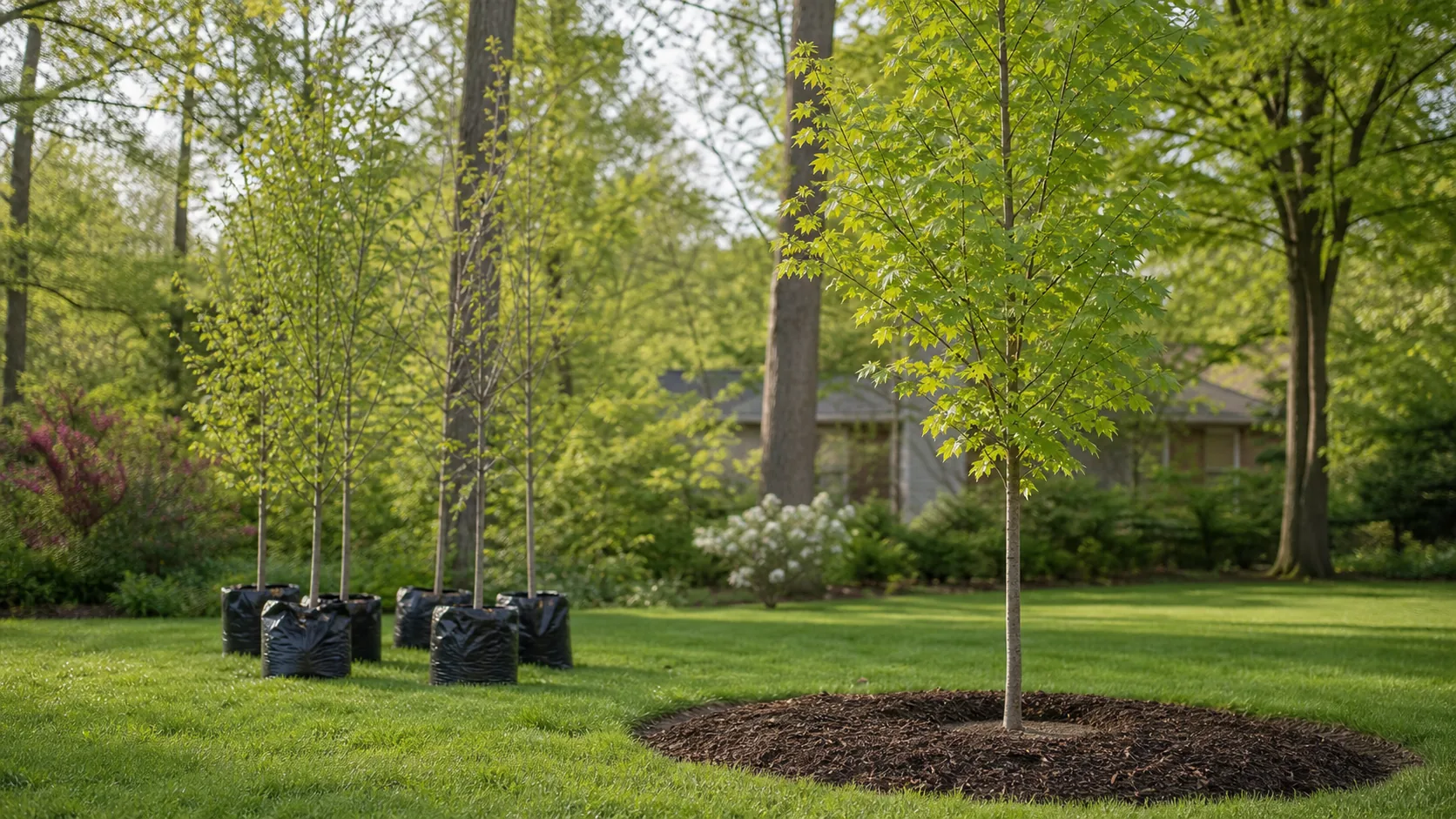
There is no universal best species
A tree that thrives in a broad, well-drained yard may struggle in a narrow strip, wet low spot, compacted construction soil, or location beneath wires. Sun, drainage, soil volume, mature dimensions, and nearby structures matter more than a generic ranked list.
Choosing a shade tree starts with the mature canopy, root space, soil, drainage, utility clearance, and maintenance needs—not a one-size-fits-all list.
Measure the available space
Look up and outward before selecting a tree. Note overhead lines, roof edges, streetlights, neighboring property, sidewalks, driveways, and visibility needs. Then consider the expected mature height and crown width rather than the nursery size.
Roots also need usable soil. Restricted planting spaces and close pavement increase the potential for future conflicts, as USDA Forest Service research on roots and hardscape explains. A smaller-maturing species may be the responsible choice in a constrained location.
Observe drainage and soil
Watch how water moves after rain. Standing water, a compacted subsoil layer, or rapid drying changes which species are likely to establish. A laboratory soil test can provide more useful information than guessing from color or texture alone.
Do not automatically replace excavated soil with a rich amendment pocket. Abrupt differences can affect water movement and root expansion. Follow current, site-appropriate planting guidance and the nursery's root-ball requirements.
Favor diversity over a single fashionable tree
A neighborhood or property dominated by one species is more vulnerable to a pest or disease that targets that tree. University of Tennessee Extension recommends planting a diversity of well-adapted species to reduce disease losses.
Diversity also means matching several micro-sites rather than forcing one choice everywhere. A wet corner, sunny front yard, and narrow side yard can support different mature forms and maintenance needs.
Consider well-adapted candidates
Depending on site conditions and available cultivars, property owners may discuss regionally native or adapted oaks, blackgum, bald cypress for suitable moisture conditions, American hornbeam, Kentucky coffeetree, or other locally recommended trees with Extension, a qualified nursery, or an arborist.
This is a conversation list, not a promise that every species fits every Memphis property. Cultivar, source, pest pressures, soil, water, and space must be checked. Avoid planting a large-maturing tree beneath lines merely because it is locally native.
Inspect nursery stock
Look for an appropriate trunk taper, well-distributed branches, a visible root flare, and roots that are not severely circling or constrained. Avoid damaged bark, major included unions, or a root ball whose condition cannot be examined according to nursery policy.
A larger container is not automatically a better value. Smaller stock can be easier to handle and may establish efficiently when planted and cared for properly. Ask about source, warranty terms, delivery, and who is responsible for establishment care.
Plant at the correct depth
The root flare should be located and the tree set so it is not buried too deeply. The planting hole and backfill should follow current guidance for the stock type and soil. Remove or manage packaging materials as recommended rather than leaving hidden restrictions around the trunk or roots.
Water to settle soil and establish root contact without saturating the site. Apply a moderate mulch layer over the root area while keeping mulch off the trunk. Stakes should only be used when needed and reviewed for timely removal.
Plan care before purchase
Young trees require monitoring through establishment. Define who waters, how soil moisture will be checked, when ties or guards are inspected, and how competing turf is managed. Avoid routine fertilizer or chemical treatments without evidence of need.
Before digging, use the appropriate utility-locating process and identify private lines. Confirm any right-of-way or neighborhood requirements. When requesting a quote, share the planting area, mature-space limits, drainage observations, and desired shade objective—not only a species name.
- Mature height and crown fit the site
- Adequate soil volume and drainage
- Safe distance from utilities and hardscape
- Diversity among existing nearby trees
- A written establishment-care plan
Think beyond first-year appearance
A tree's mature shade pattern, leaf and fruit drop, branch clearance, wildlife value, and maintenance needs affect how it fits daily use. Ask how the crown is expected to develop and where roots will have room, rather than choosing mainly for nursery flowers or rapid early growth.
Document the species, cultivar, source, planting date, root condition, and care instructions. That record helps future owners and tree professionals distinguish establishment stress from new problems and supports more consistent care.
Turn general guidance into a site-specific decision
An online article can help organize questions, but it cannot see the tree, soil, targets, utilities, access, or recent changes at a property. Use the guidance as preparation for an on-site conversation. Describe observations accurately, avoid declaring a diagnosis, and ask the evaluator to connect each recommendation to conditions that can be explained.
Request a written scope that identifies the tree or area, objective, included work, exclusions, cleanup, access protection, and responsibility for utilities or permits. If two proposals recommend different outcomes, resolve that difference before comparing price. A pruning proposal, a hazard-stabilization proposal, and a full-removal proposal are not interchangeable even when they concern the same tree.
Before authorizing work, review current qualifications, insurance documentation, contract terms, and local requirements that apply to the project.
Safety takes priority over estimate gathering. Stay away from active movement, hanging wood, and every tree or object touching a power line. Call emergency services for an immediate threat to life or critical access and contact the serving utility for electrical hazards. Website forms and ordinary quote requests are not emergency-dispatch channels.
- Observe and photograph only from a safe location
- Compare equivalent written scopes
- Review project documents before authorizing work
- Use emergency and utility channels when hazards are active
Sources and further reading
These references support the general safety and tree-care guidance above. They do not replace an on-site evaluation of a particular tree.
- Disease Management for Shade and Ornamental Trees — University of Tennessee Extension
- A Review of Tree Root Conflicts with Sidewalks, Curbs, and Roads — USDA Forest Service
- Planting and Establishing Trees — University of Tennessee Extension