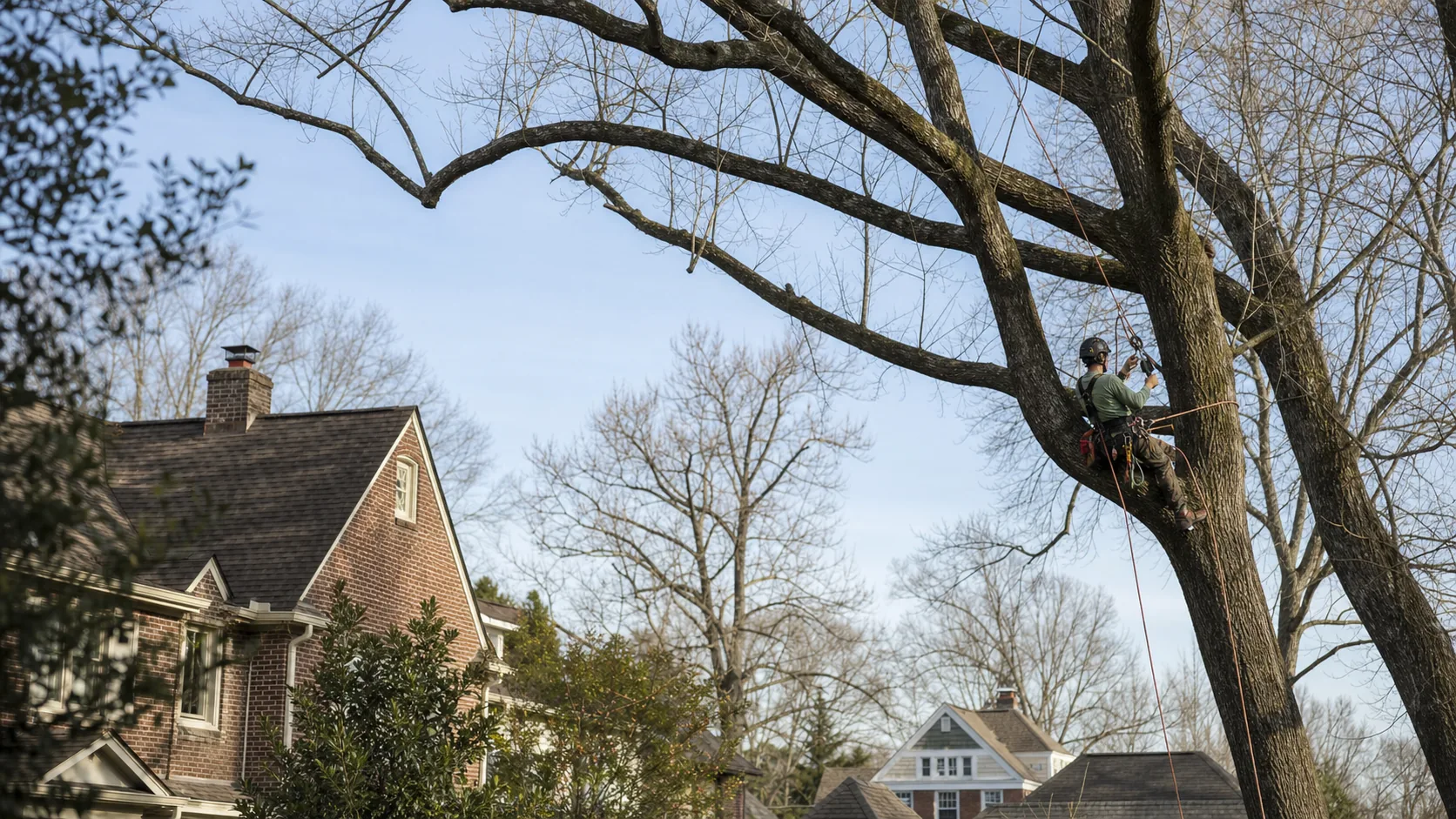
Start with the reason for pruning
The best pruning window is not identical for every Memphis tree. Removing a broken branch after a storm is different from developing structure in a young tree, clearing a roof, or reducing dead wood in a mature canopy. The objective determines how urgent the work is and which season offers the least stress.
A useful assessment identifies the species, age, condition, target branches, and nearby people or property. Memphis Tree Service Pro accepts pruning and trimming quote requests throughout the Memphis area.
Late winter is often practical, but not universal
For many deciduous trees, late winter dormancy makes branch structure easier to see and avoids removing a large amount of active foliage. Cooler conditions may also reduce disruption to a landscaped yard. That is a general planning advantage, not a universal prescription for every species or health problem.
Flowering time matters. Pruning a spring-flowering tree before bloom can remove flower buds even when the cut is otherwise acceptable. Trees with active disease concerns may require different timing. Ask the evaluator to explain why the proposed month fits the particular species and purpose instead of accepting a one-season rule.
Spring calls for restraint and observation
Bud break and leaf expansion reveal dead twigs, uneven growth, and storm damage that was easy to miss in winter. Light corrective work may be appropriate, but removing a large share of live foliage during this energy-intensive period can be counterproductive. Avoid turning an observation into an aggressive cut list without a clear goal.
Spring is also useful for recording changes. Photograph the crown from the same safe location, note branches that fail to leaf out, and watch for cracks or hanging limbs. This record helps an independent professional distinguish a long-standing feature from a recent decline.
Summer pruning should have a defined purpose
A full canopy makes clearance conflicts and dead branches easier to see. Selective summer pruning can address a specific obstruction or defect, but broad thinning simply to let in more light may remove too much leaf area and expose previously shaded bark. The amount and location of live tissue removed matter as much as the season.
Memphis heat adds another planning consideration. Discuss site access, turf protection, heat-safety planning, and cleanup before work. Never schedule around an arbitrary promise that summer pruning will prevent all storm damage; no pruning method can guarantee that a tree or branch will not fail.
Fall is a good time to plan
Fall color and leaf drop can reveal thinning crown sections, dead branches, and unions that deserve a closer look. It is a useful time to gather photos and arrange a winter assessment. Work that is not urgent can then be scoped thoughtfully rather than rushed immediately before severe weather.
Avoid assuming every dropping branch signals disease. Normal twig shedding, drought response, insects, soil changes, and structural defects can look similar from the ground. Diagnosis should precede treatment, especially before chemical applications or major pruning.
Storm damage overrides the calendar
A newly split limb, suspended branch, moving root plate, or tree touching a utility line needs attention regardless of season. Create distance, keep people out of the possible fall area, and contact the utility first when wires are involved. Do not stand under damaged wood to take photographs.
After immediate hazards are controlled, ask whether broken branches can be pruned back to suitable unions and whether the remaining structure is viable. A storm does not automatically mean the whole tree must be removed, but a decision may require an on-site tree-risk evaluation.
Good cuts matter more than a busy schedule
Proper pruning retains the tree's natural form, uses suitable branch-removal cuts, and avoids unnecessary wounds. University of Tennessee Extension warns that topping creates large wounds and weak, vigorous regrowth. A proposal to indiscriminately shorten every major limb should prompt questions before work begins.
Ask the written scope to identify which branches will be removed, the approximate percentage of live crown affected, and how the work serves the stated objective. It should distinguish pruning from removal, hauling, and optional cleanup so quotes can be compared fairly.
- Prioritize dead, broken, rubbing, or structurally problematic branches
- Preserve a balanced crown and adequate live foliage
- Avoid topping, flush cuts, and unexplained removal of large healthy limbs
- Keep cuts and workers away from energized conductors
Prepare a useful request
Provide the tree's location, safe wide-angle photos, the reason for pruning, and any recent changes. Include access limitations such as gates, slopes, pools, fences, or soft ground. Those details help determine whether an on-site visit is needed before quoting.
Before hiring, review current credentials, insurance documentation, the written scope, and responsibility for permits or utility coordination. For related planning, see the Memphis tree-trimming guide and the emergency guide linked below.
A simple annual planning rhythm
Use winter for structure photographs, spring for leaf-out comparison, summer for canopy and clearance observations, and fall for planning non-urgent work. This rhythm does not prescribe pruning every year; it creates a record so changes and genuine objectives are easier to explain.
Keep invoices and post-work photographs with the tree record. Note the branches removed and the reason. Future evaluators can then avoid repeating work unnecessarily and can compare growth, wound response, and new conditions across seasons.
Turn general guidance into a site-specific decision
An online article can help organize questions, but it cannot see the tree, soil, targets, utilities, access, or recent changes at a property. Use the guidance as preparation for an on-site conversation. Describe observations accurately, avoid declaring a diagnosis, and ask the evaluator to connect each recommendation to conditions that can be explained.
Request a written scope that identifies the tree or area, objective, included work, exclusions, cleanup, access protection, and responsibility for utilities or permits. If two proposals recommend different outcomes, resolve that difference before comparing price. A pruning proposal, a hazard-stabilization proposal, and a full-removal proposal are not interchangeable even when they concern the same tree.
Before authorizing work, review current qualifications, insurance documentation, contract terms, and local requirements that apply to the project.
Safety takes priority over estimate gathering. Stay away from active movement, hanging wood, and every tree or object touching a power line. Call emergency services for an immediate threat to life or critical access and contact the serving utility for electrical hazards. Website forms and ordinary quote requests are not emergency-dispatch channels.
- Observe and photograph only from a safe location
- Compare equivalent written scopes
- Review project documents before authorizing work
- Use emergency and utility channels when hazards are active
Sources and further reading
These references support the general safety and tree-care guidance above. They do not replace an on-site evaluation of a particular tree.
- Topping Trees: The Cost of Poor Pruning — University of Tennessee Extension
- Managing Hazards and Risk — International Society of Arboriculture
- Recognizing Tree Hazards — University of Tennessee Extension