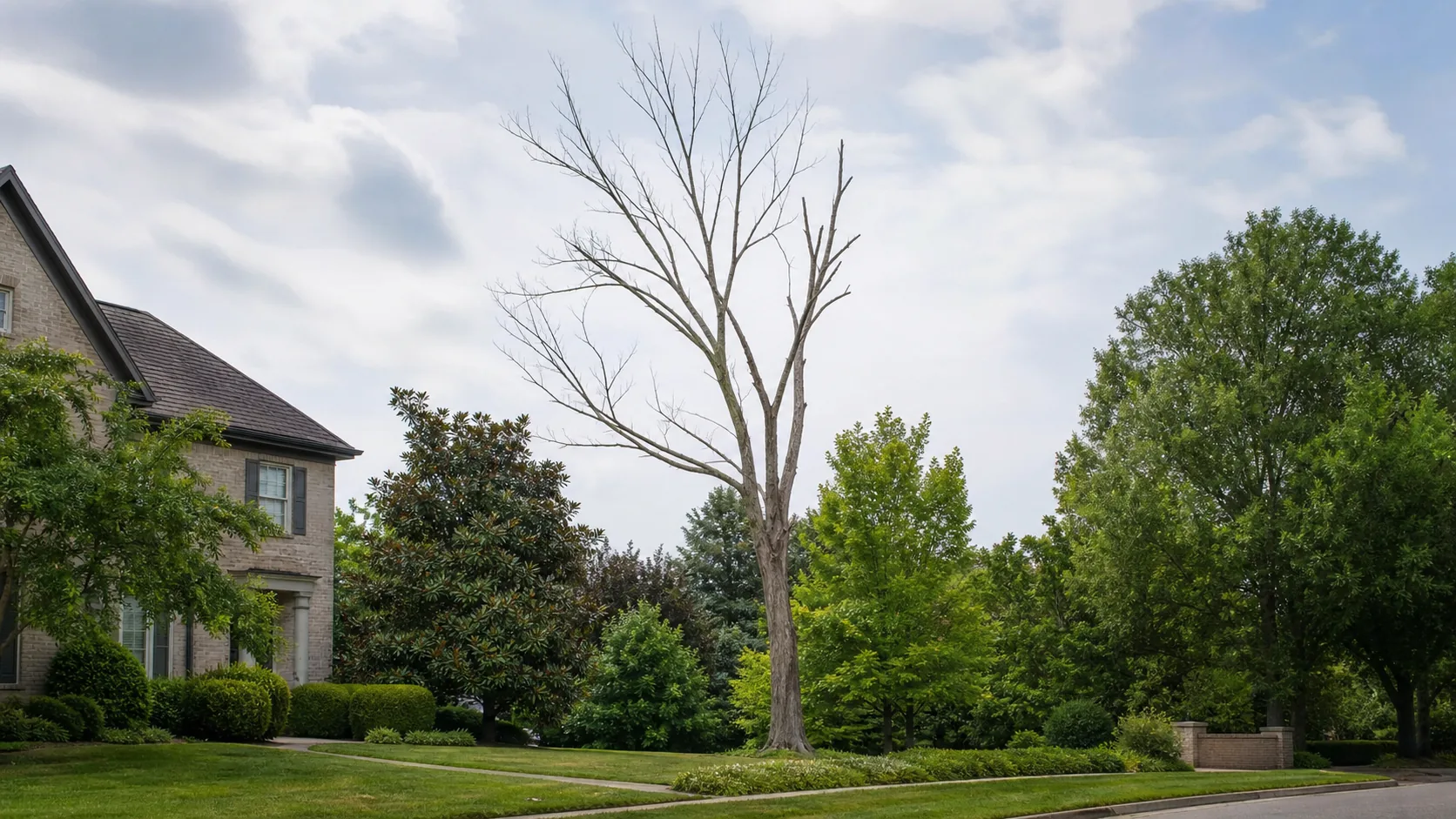
Begin with diagnosis, not an assumption
A tree without leaves may be dormant, stressed, late to leaf out, or dead. Species and season matter. Compare similar trees nearby, look for live buds from the ground, and record when the change began. Avoid cutting bark or breaking reachable twigs repeatedly as a do-it-yourself diagnostic test.
An in-person evaluation can consider the trunk, root flare, crown, recent construction, drainage, and local growing conditions before any recommendation is made.
Signs that deserve a closer look
A uniformly bare crown during the growing season, brittle fine twigs, extensive bark loss, basal decay, fungal structures, or progressive dieback can indicate serious decline. None of these observations alone establishes the exact cause or failure timeline. A tree may retain sound sections even when other parts are dead.
Look from a safe distance. Do not strike cavities, pull loose bark, climb the tree, or stand beneath dead branches. Dead wood can break with little warning, and testing it from below creates avoidable exposure.
Risk depends on targets
A dead tree beside a bedroom, driveway, play area, sidewalk, or neighboring property generally warrants more prompt evaluation than a snag in an unused woodland corner. Tree risk considers both the chance of failure and the consequence if failure occurs. Location changes the decision.
In limited low-use settings, a dead tree may have habitat value if it can remain without creating unacceptable risk. That choice should account for property boundaries, future use, fire concerns, and how decay will progress. It is not appropriate beneath occupied areas or utility lines.
Recent changes increase urgency
A fresh lean, lifted soil, new trunk crack, falling large limbs, or sudden change after wind or saturated soil should be treated differently from slow decline. Create distance and seek prompt evaluation. Contact the utility first when any part of the tree touches or threatens a line.
Construction can also change stability. Trenching, grade changes, paving, soil compaction, and root cutting may not show immediate canopy symptoms. Tell the evaluator about work near the tree even if it happened months or years earlier.
Removal is a plan, not just a cut
Dead wood may be less reliable for climbing and rigging, so the work method must account for the actual condition and access. Nearby structures, roads, fences, and landscaping may require pieces to be controlled. Ask the written scope to explain the work zone and property protection.
Clarify whether logs, branches, and chips will be hauled or left. Stump grinding, backfill, and final grading are often separate. A clear desired end condition prevents two otherwise similar estimates from appearing artificially far apart.
Avoid unsupported promises
No evaluator can guarantee exactly when a dead tree will fail. Be cautious with certainty-based sales language. A reasonable recommendation explains observed conditions, targets, alternatives, and the limits of the assessment.
Review current insurance documentation, qualifications, and contract terms. Ask who obtains any required approvals and who contacts utilities for the specific job.
Gather safe, useful information
Photograph the full tree, crown, trunk base, visible defects, and route from the street without entering the fall zone. Note whether the tree leafed out in the previous season, when branches began dropping, and whether excavation or storm damage occurred nearby.
Identify property lines and nearby public right-of-way. A tree near a sidewalk or street may involve a municipality or utility. Do not authorize work across a boundary until responsibility and access are clear.
Use observations as a starting point
A quote request should describe observations rather than declaring a diagnosis. Say “the upper crown did not leaf out” or “a new crack appeared after the storm.” This helps prepare for an assessment without treating an unverified conclusion as fact.
Compare written estimates for the same scope and review the project documents. The related Germantown and removal pages offer additional planning questions.
What to monitor when work is not immediate
If an evaluator recommends monitoring, write down the observations, inspection interval, and trigger conditions. Changes such as expanding cracks, new fungal structures, falling large wood, or soil movement should be documented from safe positions and reported.
Monitoring is an active plan, not permission to forget the tree. Keep targets managed, avoid new excavation near roots, and update the evaluation after severe weather or a material change in property use.
Turn general guidance into a site-specific decision
An online article can help organize questions, but it cannot see the tree, soil, targets, utilities, access, or recent changes at a property. Use the guidance as preparation for an on-site conversation. Describe observations accurately, avoid declaring a diagnosis, and ask the evaluator to connect each recommendation to conditions that can be explained.
Request a written scope that identifies the tree or area, objective, included work, exclusions, cleanup, access protection, and responsibility for utilities or permits. If two proposals recommend different outcomes, resolve that difference before comparing price. A pruning proposal, a hazard-stabilization proposal, and a full-removal proposal are not interchangeable even when they concern the same tree.
Before authorizing work, review current qualifications, insurance documentation, contract terms, and local requirements that apply to the project.
Safety takes priority over estimate gathering. Stay away from active movement, hanging wood, and every tree or object touching a power line. Call emergency services for an immediate threat to life or critical access and contact the serving utility for electrical hazards. Website forms and ordinary quote requests are not emergency-dispatch channels.
- Observe and photograph only from a safe location
- Compare equivalent written scopes
- Review project documents before authorizing work
- Use emergency and utility channels when hazards are active
Sources and further reading
These references support the general safety and tree-care guidance above. They do not replace an on-site evaluation of a particular tree.
- Recognizing Tree Hazards — University of Tennessee Extension
- Managing Hazards and Risk — International Society of Arboriculture
- Safety After the Storm — National Weather Service