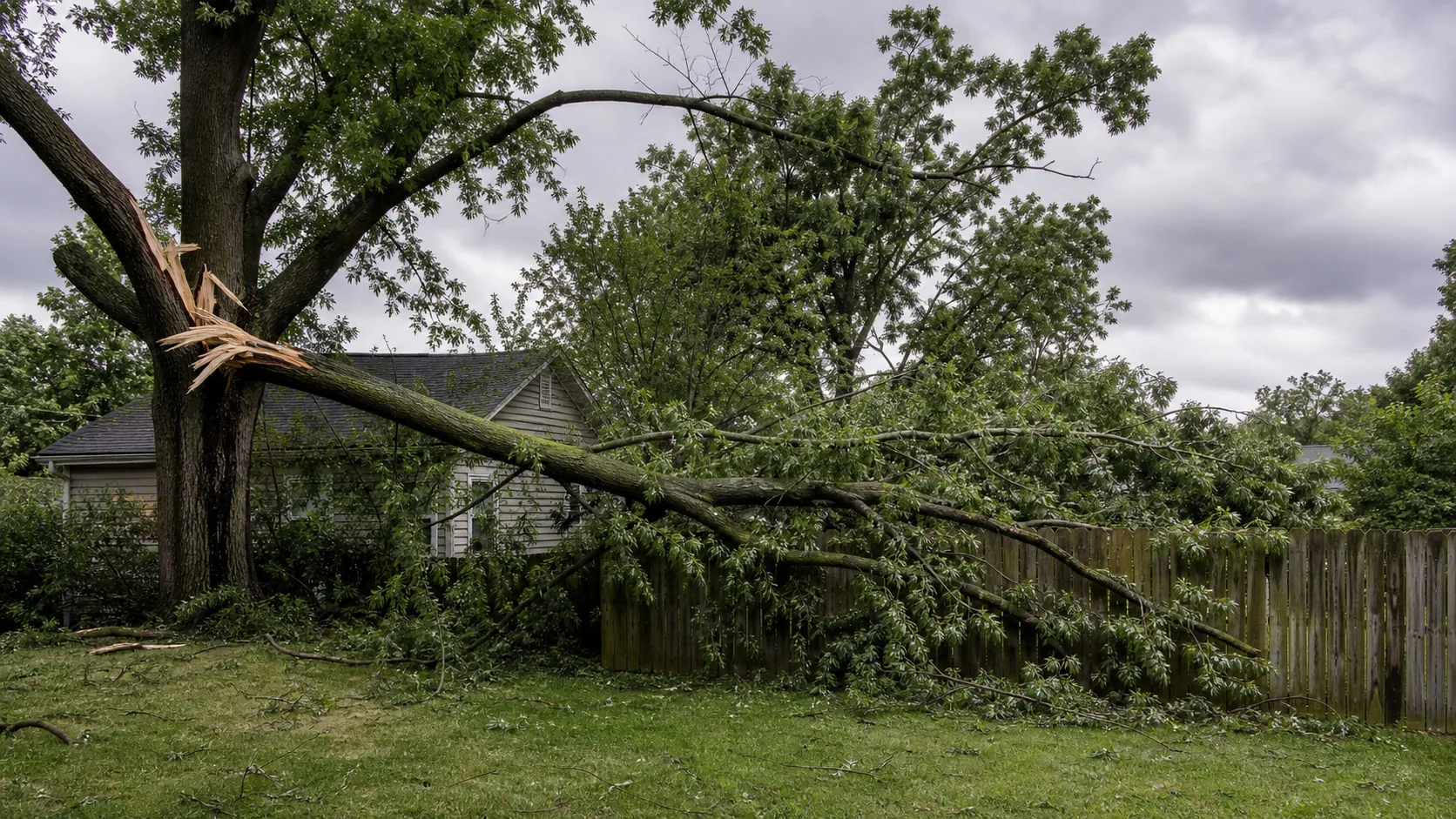
1. Create distance before inspecting
Storm damage can leave branches suspended, trunks split, and root plates partly lifted. These conditions may continue moving after wind or rain stops. Keep people, pets, and vehicles outside the possible fall area and do not walk beneath damaged wood to see it more closely.
Call emergency services when a tree creates an immediate threat to life, blocks an emergency exit, or obstructs a critical public route. A website submission is not a substitute for an urgent call, and electrical hazards should be reported to the serving utility.
2. Treat every wire as energized
Never touch a branch, tree, fence, vehicle, or puddle that may be in contact with a downed line. The National Weather Service advises staying away from power lines and objects touching them. Electricity can travel through materials that do not look dangerous from a distance.
Notify the electric utility and follow its directions. Tree work may need to wait until the utility makes the area safe. Do not assume that a quiet line is de-energized, and do not attempt to cut or pull a limb away with household tools or a vehicle.
3. Protect access and secondary targets
Move people away from rooms beneath damaged branches when it can be done without passing through the hazard area. Keep driveways and gates clear for responders. If it is safe, move uninvolved vehicles and patio furniture farther away, but never retrieve property from beneath a hanging limb.
Use visible barriers at a safe distance so family members and visitors do not wander into the area. A branch supported by another branch can shift without warning, especially as wood dries or wind returns.
4. Record conditions without entering the fall zone
Photograph the whole scene from multiple safe locations. Include the tree, damage, nearby structures, and access from the street. Note the date and approximate time the damage was discovered. Do not climb onto a roof or under a leaning tree for a closer image.
If property is damaged, contact the insurer and ask what documentation or authorization it needs before non-emergency cleanup. Coverage and claim procedures vary, so do not assume a particular item will be reimbursed.
5. Describe the hazard accurately
When requesting help, say whether lines, roads, roofs, vehicles, fences, or neighboring property are involved. Mention fresh cracks, lifted soil, active movement, and hanging pieces without diagnosing the tree. Clear information helps establish urgency and site limitations.
Do not describe every damaged tree as an emergency simply to seek faster service. A broken twig away from people is different from a split leader above a bedroom. Accurate triage helps truly urgent calls receive appropriate attention.
6. Separate stabilization from final work
The first scope may only remove an immediate hazard or open access. Final pruning, full removal, stump work, and landscape restoration can be separate decisions. Ask the written scope to state what the emergency phase includes and what condition the site will be left in.
A storm-damaged tree is not automatically a total loss. An on-site evaluation may identify repairable branches, a need for monitoring, or defects that make removal reasonable. Ask for the observed basis and alternatives rather than accepting a fear-based recommendation.
7. Review the written scope
Storms attract rushed decisions. Review current insurance documentation, qualifications, the written scope, and payment terms. Be cautious about pressure to sign immediately, large unexplained deposits, or promises of guaranteed insurance coverage. Keep copies of estimates, contracts, and receipts.
Confirm who will perform the work, which equipment is planned, what cleanup is included, and who coordinates utilities or public access.
- People and utilities addressed first
- Hazard area visibly isolated
- Photos taken only from safe positions
- Written emergency and final scopes separated
- Project documents reviewed before work
Plan before the next warning
Periodic inspection of large or concerning trees can identify changes before severe weather. Note new leans, cracks, dead branches, construction near roots, and soil movement. Risk cannot be eliminated, but routine observation and appropriate care can support informed decisions.
Save utility and emergency numbers before storms are forecast. Keep recent wide photos of important trees and know how responders can enter the property. Those small preparations are more useful than relying on an online form during an active hazard.
After the urgent phase
Revisit the property after hazards are stabilized. Record remaining broken branches, root damage, ruts, debris, and exposed soil. Ask which items were intentionally deferred and whether the tree or neighboring trees need another inspection after leaves return.
Separate tree work from roof, fence, pavement, and landscape restoration. Those trades may require separate scopes. Written handoffs keep a temporary safety action from being mistaken for a complete repair.
Turn general guidance into a site-specific decision
An online article can help organize questions, but it cannot see the tree, soil, targets, utilities, access, or recent changes at a property. Use the guidance as preparation for an on-site conversation. Describe observations accurately, avoid declaring a diagnosis, and ask the evaluator to connect each recommendation to conditions that can be explained.
Request a written scope that identifies the tree or area, objective, included work, exclusions, cleanup, access protection, and responsibility for utilities or permits. If two proposals recommend different outcomes, resolve that difference before comparing price. A pruning proposal, a hazard-stabilization proposal, and a full-removal proposal are not interchangeable even when they concern the same tree.
Before authorizing work, review current qualifications, insurance documentation, contract terms, and local requirements that apply to the project.
Safety takes priority over estimate gathering. Stay away from active movement, hanging wood, and every tree or object touching a power line. Call emergency services for an immediate threat to life or critical access and contact the serving utility for electrical hazards. Website forms and ordinary quote requests are not emergency-dispatch channels.
- Observe and photograph only from a safe location
- Compare equivalent written scopes
- Review project documents before authorizing work
- Use emergency and utility channels when hazards are active
Sources and further reading
These references support the general safety and tree-care guidance above. They do not replace an on-site evaluation of a particular tree.
- Safety After the Storm — National Weather Service
- Managing Hazards and Risk — International Society of Arboriculture
- Recognizing Tree Hazards — University of Tennessee Extension