Symptoms are not diagnoses
Leaf spots, thinning crowns, mushrooms, bark loss, and dead branches can result from disease, insects, drought, flooding, root injury, planting depth, chemical exposure, or multiple stresses together. A photograph may support triage but cannot reliably identify every cause or show the extent of internal decay.
A professional evaluation may include closer inspection, testing, or laboratory analysis before treatment is recommended. No treatment can guarantee that a declining tree will recover.
Record the whole-tree pattern
Note whether symptoms occur on one branch, one side, the lower crown, new growth, or the entire tree. Compare nearby trees of the same species. A uniform pattern can suggest a different issue from scattered spots, while one-sided decline may point to site or root changes.
Take wide photographs before close-ups. Include the crown, trunk base, soil, drainage, and surrounding construction. Do not climb, break branches, or enter a fall zone to collect better images.
Leaves provide timing clues
Record when discoloration, spots, curling, scorch, early drop, or reduced leaf size began. Weather and irrigation history matter. Some foliar diseases are mostly cosmetic in a given year; other patterns reflect broader stress. The same brown margin can have several causes.
Do not assume a fungicide will reverse existing leaf damage. University of Tennessee Extension notes that many fungicides are protective and must be timed before or during infection. Product selection and use should follow a confirmed diagnosis and label requirements.
Branches and trunk need context
Cankers, sap flow, bark cracks, holes, galleries, cavities, and dieback deserve documentation. Their importance depends on species, location, extent, and what could be struck. A cavity near a major union is not evaluated the same way as superficial bark damage away from targets.
Avoid painting wounds, filling cavities, or drilling into the trunk as a home test. These actions can obscure evidence or damage living tissue. Ask the evaluator what can be concluded visually and whether additional assessment is warranted.
Fungi are evidence, not a verdict
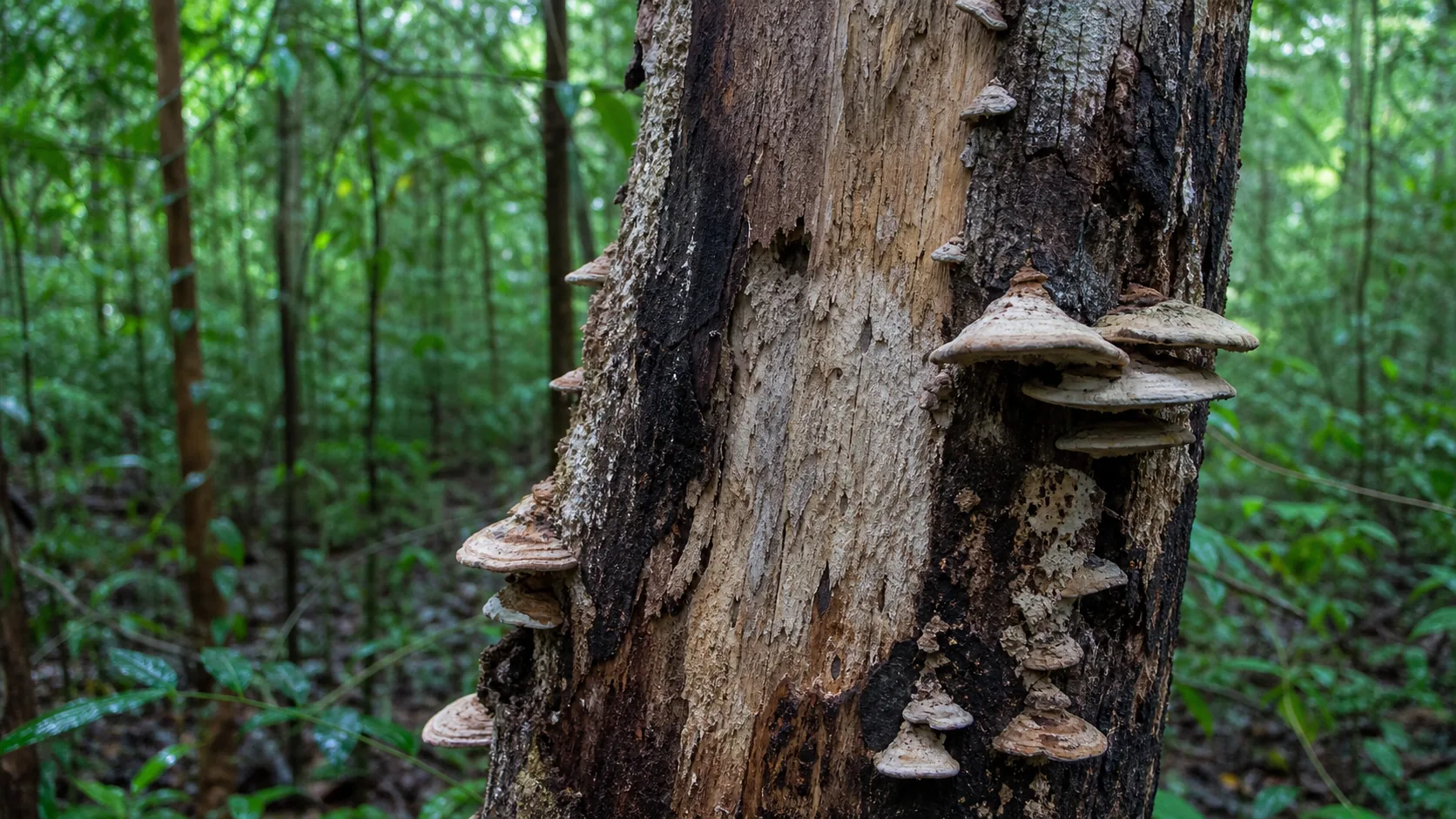
Mushrooms or conks can be associated with decaying wood, but identification and location matter. Photograph the top, underside, attachment point, and surrounding tree without removing the structure. Note whether it appeared at the trunk, root flare, an old wound, or a separate piece of buried wood.
Do not eat or handle unknown fungi unnecessarily. Removing the visible fruiting body does not remove internal decay. The management decision should consider the tree and targets, not simply the presence of a mushroom.
Root and soil stress can look like disease
Construction, compaction, trenching, grade changes, standing water, irrigation changes, and buried root flares can contribute to canopy decline. Ask what changed in the site before symptoms appeared. Old damage may take time to become visible above ground.
Pulling soil away or cutting roots without a plan can create new problems. A coordinated assessment may involve tree, soil, drainage, utility, or landscape expertise depending on the site.
Treatment should match the cause
Reasonable recommendations may include improving water management, mulching correctly, pruning selected dead or infected branches, sanitation, monitoring, laboratory confirmation, targeted treatment, or replacement. Not every problem needs a chemical, and not every declining tree needs immediate removal.
Ask what diagnosis supports the treatment, what outcome is realistic, how long it will be evaluated, and what limitations remain. Guarantees of a cure or blanket annual injections without a clear diagnosis deserve scrutiny.
Know when safety changes the priority
Active cracking, a new lean, a lifting root plate, suspended large limbs, or contact with utilities calls for safety action rather than a routine plant-health visit. Keep people away and contact the utility or emergency services as appropriate.
For non-immediate concerns, assemble a simple timeline, photographs, species if known, and recent site changes. Review current qualifications, insurance documentation, the written scope, and any pesticide credentials required for proposed applications.
- Whole-tree and close-up photographs
- Date symptoms first appeared and how they changed
- Recent weather, irrigation, construction, and soil changes
- Treatments already attempted
- People or property within reach of affected parts
Use samples responsibly
When laboratory or Extension help is appropriate, ask how to collect and package a representative sample. A random dead twig may not contain useful evidence, and poor handling can make diagnosis harder. Follow the receiving service's instructions rather than mailing unknown material unannounced.
Record the tree species if known, site history, symptom pattern, and dates with the sample. Keep treatment decisions tied to the result and current label guidance, not to an online photo comparison alone.
Turn general guidance into a site-specific decision
An online article can help organize questions, but it cannot see the tree, soil, targets, utilities, access, or recent changes at a property. Use the guidance as preparation for an on-site conversation. Describe observations accurately, avoid declaring a diagnosis, and ask the evaluator to connect each recommendation to conditions that can be explained.
Request a written scope that identifies the tree or area, objective, included work, exclusions, cleanup, access protection, and responsibility for utilities or permits. If two proposals recommend different outcomes, resolve that difference before comparing price. A pruning proposal, a hazard-stabilization proposal, and a full-removal proposal are not interchangeable even when they concern the same tree.
Before authorizing work, review current qualifications, insurance documentation, contract terms, and local requirements that apply to the project.
Safety takes priority over estimate gathering. Stay away from active movement, hanging wood, and every tree or object touching a power line. Call emergency services for an immediate threat to life or critical access and contact the serving utility for electrical hazards. Website forms and ordinary quote requests are not emergency-dispatch channels.
- Observe and photograph only from a safe location
- Compare equivalent written scopes
- Review project documents before authorizing work
- Use emergency and utility channels when hazards are active
Sources and further reading
These references support the general safety and tree-care guidance above. They do not replace an on-site evaluation of a particular tree.
- Disease Management for Shade and Ornamental Trees — University of Tennessee Extension
- Managing Hazards and Risk — International Society of Arboriculture
- Recognizing Tree Hazards — University of Tennessee Extension