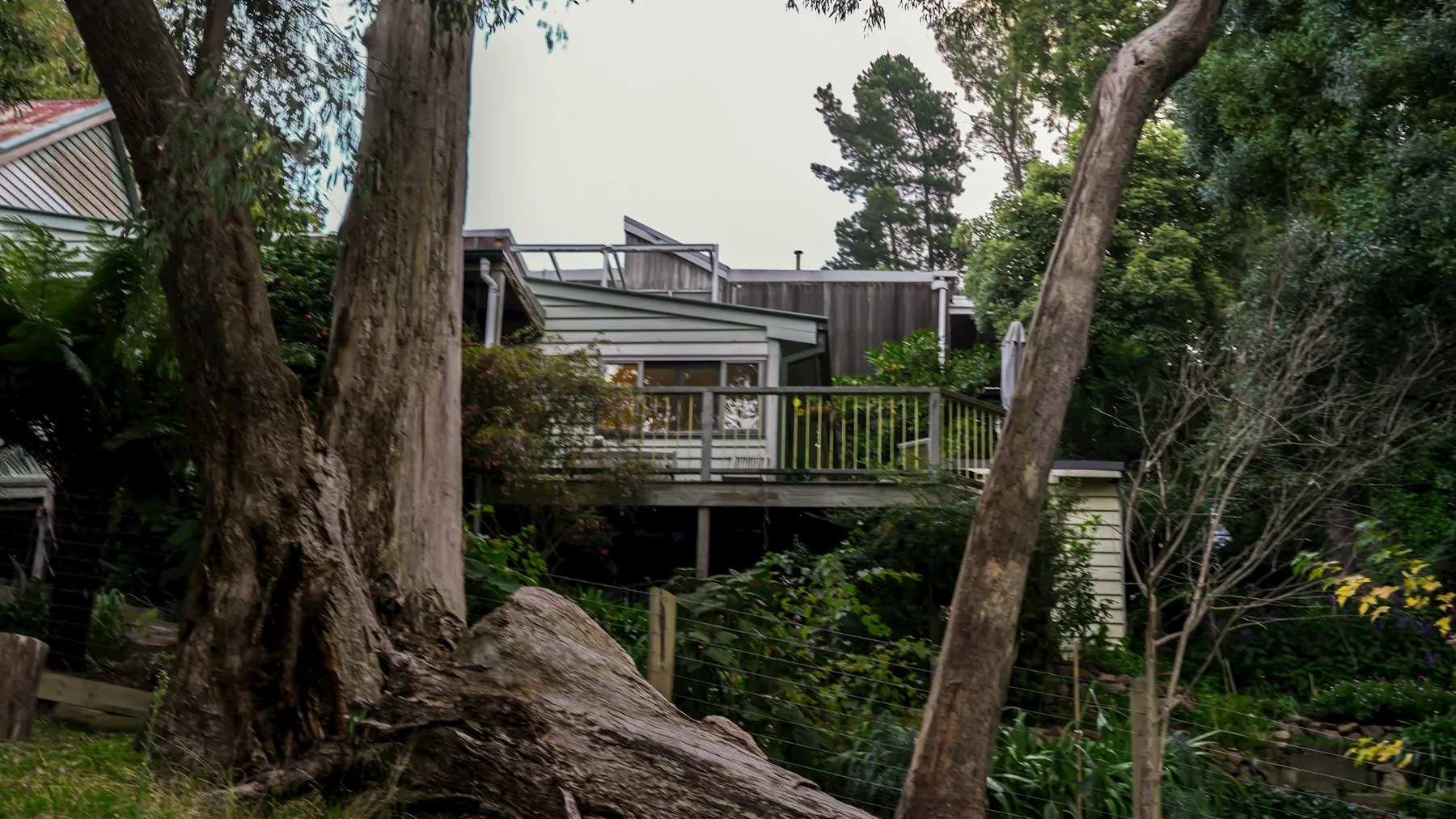
Start by creating distance
If a tree is moving, cracking, uprooting, or dropping limbs, move people and pets away. Do not walk beneath a hanging branch, park in the possible fall path, or attempt to stabilize the tree. From a safe location, call emergency services when there is an immediate threat to life or a blocked emergency route.
Online information cannot determine whether a damaged tree will fail. When there is an immediate threat to life or critical access, call emergency services; for electrical hazards, contact the serving utility.
Treat every wire as energized
Stay well away from a tree or branch touching a wire. Electricity can travel through wood, wet ground, fences, and equipment. Contact the electric utility and follow its instructions; do not touch the tree or try to move the line. Tree work may need to wait until the utility confirms the area is safe.
Warning signs after wind or heavy rain
Not every defect means failure is imminent, but new storm-related changes should be taken seriously. Safe, distant observations can help a qualified professional triage the situation.
- Fresh trunk or major-union cracks and sounds of active cracking
- A new lean, mounded soil, or roots lifting on one side
- Split, suspended, or partially attached branches
- A tree or limb resting on a roof, vehicle, fence, or another tree
- Blocked streets, driveways, exits, or access for emergency responders
Document safely and coordinate the next call
Take photos only from outside the potential fall zone. If property is damaged, contact the insurer and ask what documentation or authorization it requires before cleanup. Preserve receipts and written estimates, and do not assume insurance will cover a particular scope.
When requesting a quote, describe whether wires, structures, roads, or hanging limbs are involved and provide the property location. Review current project-specific credentials, insurance documentation, and the emergency scope before authorizing work when circumstances allow.
Know what information helps triage
A useful call states what changed, when it changed, what could be struck, whether movement is active, and whether lines or public access are involved. Describe a “fresh split at the main union” rather than only saying the tree looks bad. Give the exact property address and a safe callback number.
Weather and demand can affect emergency scheduling. Do not remain in an unsafe area waiting for a website reply. Emergency services and utilities establish their own priorities and should be contacted directly for immediate hazards.
Avoid common cleanup hazards
Bent, lodged, or suspended wood can release stored energy unexpectedly. Trees resting on structures or other trees may shift as material is cut or moved. Chainsaws, ladders, ropes, and vehicles do not make these conditions suitable for untrained cleanup. Keep bystanders away until the work zone is controlled.
Wear appropriate protection for ordinary debris only after the site has been declared safe. Nails, glass, unstable roofing, gas damage, and floodwater can remain after a storm. Tree cleanup may need to wait for building, utility, or emergency professionals to address other hazards.
Close the project with documentation
After stabilization, photograph the completed condition, retain contracts and receipts, and record any branches or stump work left for later. Ask whether the remaining tree needs follow-up observation and what changes would prompt another evaluation. Do not assume emergency pruning completes all long-term care.
If an insurer is involved, submit accurate documents and let the carrier make coverage decisions. Review invoice details and contact information. A clear record helps distinguish emergency stabilization, permanent repair, and optional landscape restoration.
Turn general guidance into a site-specific decision
An online article can help organize questions, but it cannot see the tree, soil, targets, utilities, access, or recent changes at a property. Use the guidance as preparation for an on-site conversation. Describe observations accurately, avoid declaring a diagnosis, and ask the evaluator to connect each recommendation to conditions that can be explained.
Request a written scope that identifies the tree or area, objective, included work, exclusions, cleanup, access protection, and responsibility for utilities or permits. If two proposals recommend different outcomes, resolve that difference before comparing price. A pruning proposal, a hazard-stabilization proposal, and a full-removal proposal are not interchangeable even when they concern the same tree.
Before authorizing work, review current qualifications, insurance documentation, contract terms, and local requirements that apply to the project.
Safety takes priority over estimate gathering. Stay away from active movement, hanging wood, and every tree or object touching a power line. Call emergency services for an immediate threat to life or critical access and contact the serving utility for electrical hazards. Website forms and ordinary quote requests are not emergency-dispatch channels.
- Observe and photograph only from a safe location
- Compare equivalent written scopes
- Review project documents before authorizing work
- Use emergency and utility channels when hazards are active
Sources and further reading
These references support the general safety and tree-care guidance above. They do not replace an on-site evaluation of a particular tree.
- Safety After the Storm — National Weather Service
- Managing Hazards and Risk — International Society of Arboriculture
- Recognizing Tree Hazards — University of Tennessee Extension