Two different outcomes
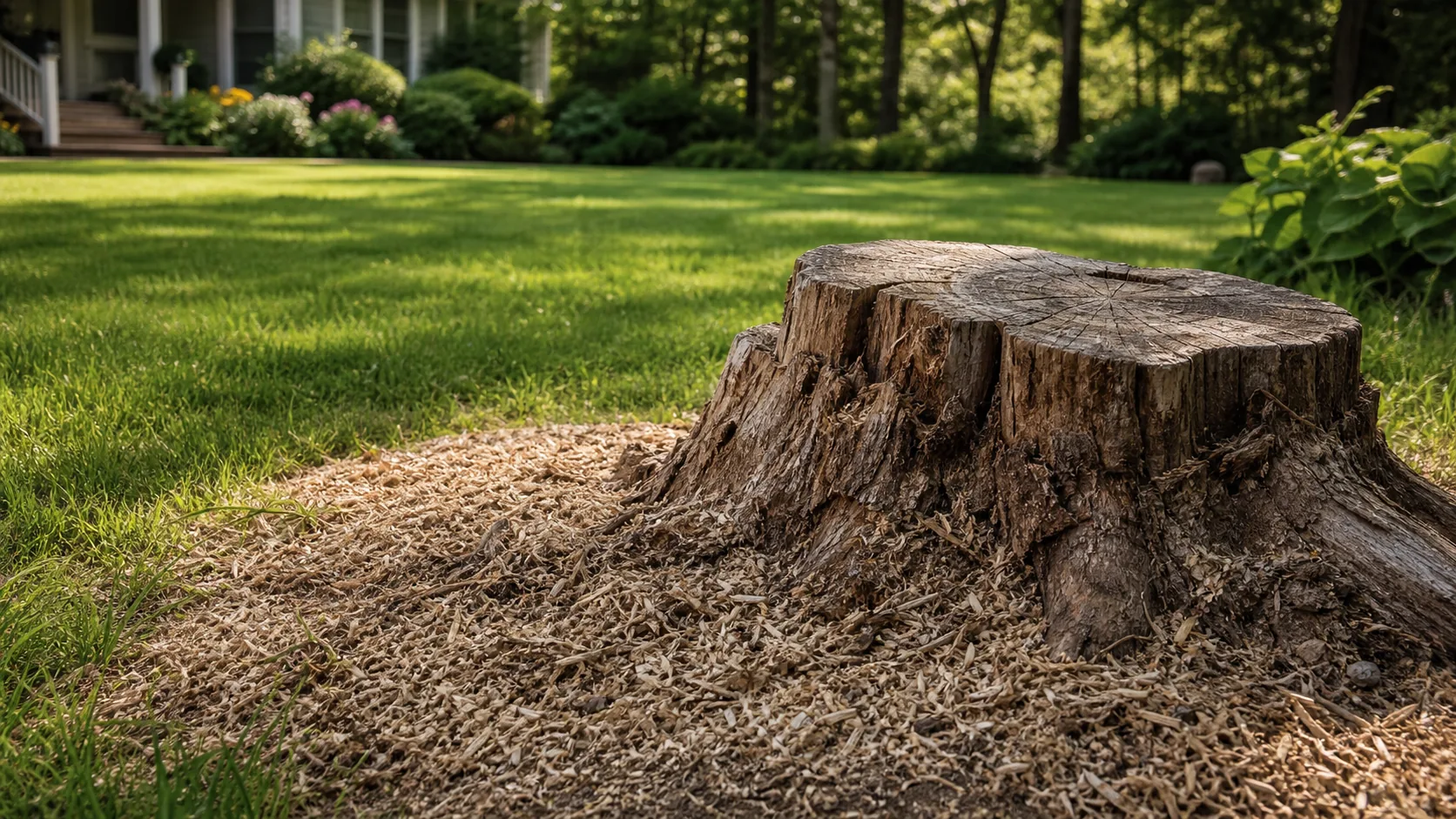
Stump grinding reduces the visible stump and upper root flare into chips, generally leaving deeper roots in place to decay over time. Full excavation attempts to remove a larger root mass and soil volume. The second option is more disruptive and may require excavation equipment, hauling, and imported soil.
Memphis Tree Service Pro accepts stump-grinding quote requests throughout the area. The appropriate method depends on the property, future use, access, utilities, and desired finished grade.
Start with the next use of the space
A future lawn or planting bed may need a different finish than a foundation, driveway, pool, or replacement tree. Grinding depth and lateral coverage should be discussed in terms of that use. “Remove the stump” is too vague to establish the final grade or root treatment.
If construction is planned, coordinate the stump scope with the designer or excavation contractor. Grinding alone should not be treated as preparation for structural work without knowing the engineering and geotechnical requirements.
Access controls equipment choices
Gate width, steps, retaining walls, slopes, delicate paving, and soft ground affect which grinder or excavator can reach the stump. Measure the narrowest point and photograph turns along the route. An open front yard is a different project from an enclosed courtyard.
Ask how the machine will travel, whether temporary ground protection is included, and who handles fences or gates that must be removed. Written access assumptions help prevent surprises on the work day.
Utilities and irrigation come first
Stump and root areas may contain electric, gas, water, sewer, communication, drainage, lighting, or irrigation components. Public utility marking does not necessarily identify private lines. Determine the appropriate locating process before disturbing soil.
Never infer that a line is clear because the original tree was planted years ago. Roots can grow around utilities, and later installations may cross the area. The estimate should state who is responsible for public and private locating.
What grinding leaves behind
Grinding creates a mixture of wood chips and soil. Depending on the volume, it may settle as wood decomposes and may not behave like clean topsoil. Ask whether chips will be removed, left as mulch, mixed into the hole, or replaced with soil.
Large lateral roots can remain beyond the immediate stump. If surface roots interfere with mowing or paving, identify them separately. Cutting structural roots of a nearby living tree is a different risk and should not be added casually to stump work.
What excavation changes
Fuller excavation may remove more woody material, but it also disturbs a larger soil volume and can affect neighboring trees, hardscape, drainage, and buried systems. The removed mass leaves a void that needs suitable backfill and compaction for the intended use.
Ask where excavated material will go and whether hauling, fill, compaction, and restoration are included. A tree-service estimate may end before final landscaping or construction begins, so trade boundaries should be clear.
Replacement planting needs its own plan
Planting a new tree directly into a chip-filled stump cavity can create poor support and uneven settling. A nearby location may be preferable, depending on available soil volume, old roots, utilities, mature size, and spacing from structures.
Select a species for the actual site rather than trying to replace the old canopy immediately with the largest nursery tree. Consider drainage, sun, overhead clearance, and long-term root space before ordering material.
Compare the complete finish
A useful written estimate identifies stump diameter, grinding depth, surface roots, access, locating, chips, hauling, backfill, and final grade. Compare the same outcome across estimates. A low number that leaves a mound of chips is not equivalent to a quote that includes removal and soil.
Review current insurance documentation, qualifications, and contract terms. Share the future use and safe site photos through the quote form, then confirm every assumption before work.
- Exact stump and visible roots included
- Minimum access width and route protection
- Utility and private-line locating responsibility
- Chip, soil, backfill, and final-grade treatment
- Construction or replanting handoff
Expect settling and follow-up
Even a carefully backfilled stump area can settle as disturbed soil and residual wood change. Ask what follow-up is included and when the area can be graded, seeded, paved, or replanted. Do not place a structural load based only on a tree-work finish.
Mark the site in project records so future owners or contractors know that roots and wood may remain. This is especially useful before irrigation, drainage, utility, or construction work crosses the former tree location.
Turn general guidance into a site-specific decision
An online article can help organize questions, but it cannot see the tree, soil, targets, utilities, access, or recent changes at a property. Use the guidance as preparation for an on-site conversation. Describe observations accurately, avoid declaring a diagnosis, and ask the evaluator to connect each recommendation to conditions that can be explained.
Request a written scope that identifies the tree or area, objective, included work, exclusions, cleanup, access protection, and responsibility for utilities or permits. If two proposals recommend different outcomes, resolve that difference before comparing price. A pruning proposal, a hazard-stabilization proposal, and a full-removal proposal are not interchangeable even when they concern the same tree.
Before authorizing work, review current qualifications, insurance documentation, contract terms, and local requirements that apply to the project.
Safety takes priority over estimate gathering. Stay away from active movement, hanging wood, and every tree or object touching a power line. Call emergency services for an immediate threat to life or critical access and contact the serving utility for electrical hazards. Website forms and ordinary quote requests are not emergency-dispatch channels.
- Observe and photograph only from a safe location
- Compare equivalent written scopes
- Review project documents before authorizing work
- Use emergency and utility channels when hazards are active
Sources and further reading
These references support the general safety and tree-care guidance above. They do not replace an on-site evaluation of a particular tree.
- A Review of Tree Root Conflicts with Sidewalks, Curbs, and Roads — USDA Forest Service
- Managing Hazards and Risk — International Society of Arboriculture
- Planting and Establishing Trees — University of Tennessee Extension