Replace the yes-or-no checklist with an evaluation
Eight common observations can justify a closer evaluation, but none proves by itself that a tree needs removal. A defect, disease symptom, or dead branch may be managed in several ways depending on severity, species, targets, and the rest of the tree.
A professional evaluation can compare pruning, support, monitoring, target management, and removal based on conditions at the property.
1. A new lean or moving root plate
A long-standing lean can be part of normal growth, while a new lean after wind or saturated soil may be urgent. Look for fresh soil cracking, mounding, exposed roots, or recent movement. Keep people away if the tree appears to be shifting.
Do not approach the base to measure the lean during active movement. From a safe location, contact emergency services for an immediate life threat and the utility if lines are involved.
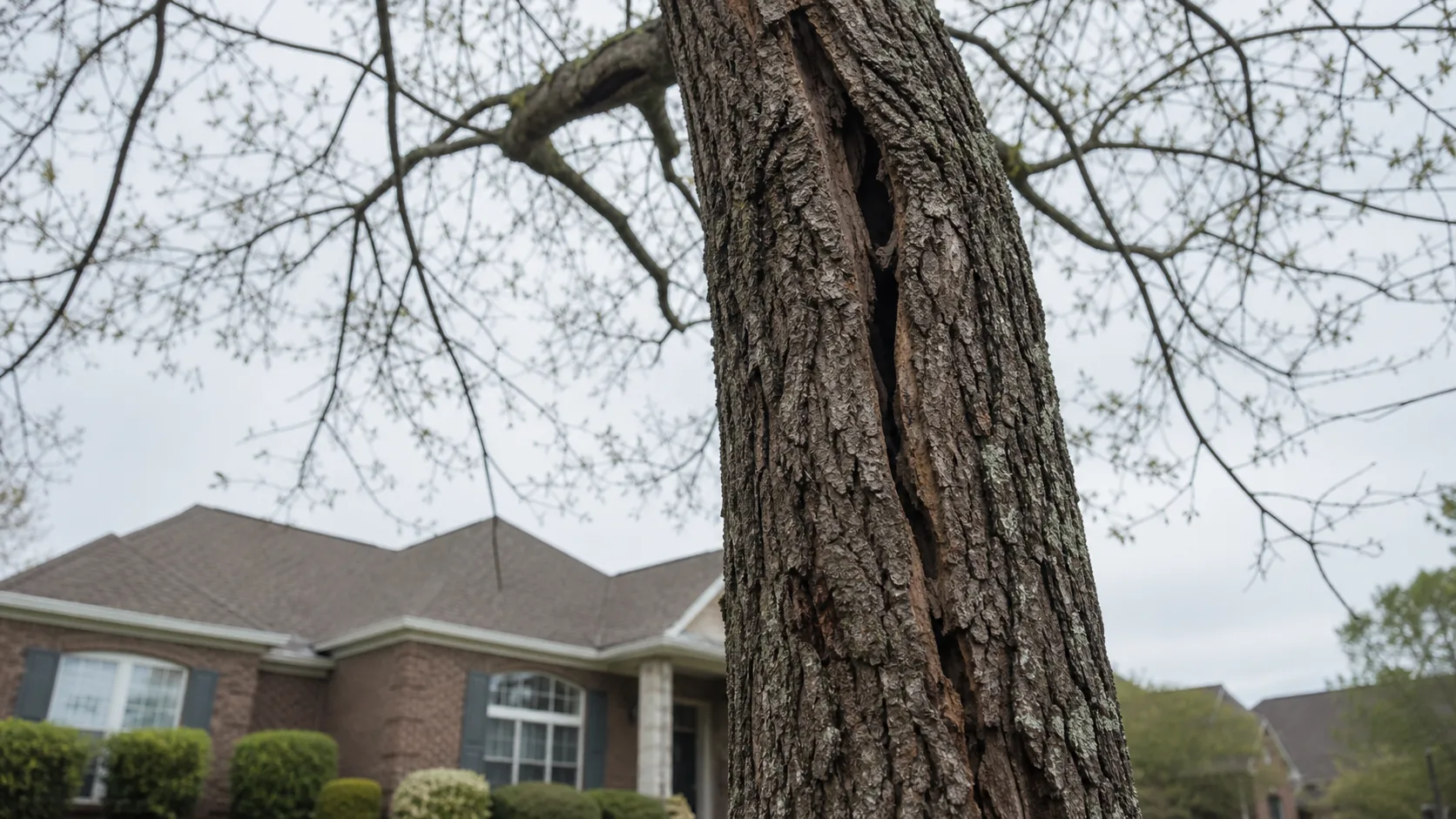
2. Fresh trunk or union cracks
A newly opened crack, active splitting sound, or separation at a major union deserves prompt assessment. Old seams and included bark require context; their appearance alone does not reveal the remaining strength or likely timing of failure.
Photograph from outside the possible fall area and note when it appeared. Avoid drilling, probing, or widening the opening yourself, because those actions can damage living tissue and do not produce a qualified risk assessment.
3. Large dead or hanging branches
Deadwood above a home, street, driveway, or play area creates a more important target than similar wood over an unused corner. Suspended branches can shift after wind stops. Isolate the area rather than attempting removal with a ladder or rope.
Selective pruning may address the branch without removing the entire tree. Ask whether the defect is localized and how the remaining crown and trunk were evaluated.
4. Cavities, decay, or fungal structures
Cavities and fungal fruiting bodies can be associated with decay, but species, location, extent, and remaining wood matter. A hollow sound or visible mushroom is not a complete diagnosis. Some trees continue to function with cavities; others require action because of the defect and target combination.
Do not remove fungal structures as a “treatment” or fill cavities with household material. Ask what additional assessment is appropriate and whether the recommendation has been limited by what could not be seen.
5. Progressive crown dieback
Increasing dead tips, sparse foliage, or failure to leaf out may reflect root stress, disease, drought, construction damage, or other causes. Compare changes across seasons and similar nearby trees. Diagnosis affects whether care, monitoring, pruning, or removal is considered.
Avoid “cure-all” treatments based only on a photograph. Soil and root conditions are often central to canopy symptoms and may need on-site investigation.
6. Root damage or construction changes
Trenching, paving, grade changes, compaction, and root cutting can affect stability and health. Problems may emerge well after construction ends. Tell the evaluator where soil was removed or added and when heavy equipment operated near the tree.
Do not cut additional roots to make pavement repairs easier without a coordinated plan. Root size, location, tree condition, and distance from the trunk influence the consequence.
7. Repeated branch failures
A history of lost limbs may reveal exposure, weak unions, decay, poor prior cuts, or species characteristics. Record where failures occurred and the weather at the time. Repeated loss does not automatically dictate removal, but it helps frame future likelihood and targets.
Ask whether pruning or target management could reduce risk and what residual risk remains. No intervention guarantees that another branch will never fail.
8. The target or use has changed
A tree can present a different risk when a new addition, play set, driveway, or gathering area is placed beneath it. Sometimes moving the target is a practical alternative to changing the tree. ISA guidance identifies target removal as one risk-management option.
A useful written recommendation connects observed conditions to the area that could be struck and compares reasonable options. Review qualifications, insurance documentation, and the scope before work begins.
- Record whether the condition is new or long-standing
- Identify people and property within reach
- Ask about pruning, monitoring, support, or target changes
- Treat utilities and active movement as urgent
Questions for the evaluator
Ask which condition was observed, which part might fail, what could be struck, what uncertainty remains, and what options could reduce risk. Request an explanation of why removal is preferred if pruning, monitoring, support, or changing the target is not recommended.
Keep the response with photographs and the written scope. If the tree crosses a property line or affects public space, resolve ownership and authorization before scheduling work.
Turn general guidance into a site-specific decision
An online article can help organize questions, but it cannot see the tree, soil, targets, utilities, access, or recent changes at a property. Use the guidance as preparation for an on-site conversation. Describe observations accurately, avoid declaring a diagnosis, and ask the evaluator to connect each recommendation to conditions that can be explained.
Request a written scope that identifies the tree or area, objective, included work, exclusions, cleanup, access protection, and responsibility for utilities or permits. If two proposals recommend different outcomes, resolve that difference before comparing price. A pruning proposal, a hazard-stabilization proposal, and a full-removal proposal are not interchangeable even when they concern the same tree.
Before authorizing work, review current qualifications, insurance documentation, contract terms, and local requirements that apply to the project.
Safety takes priority over estimate gathering. Stay away from active movement, hanging wood, and every tree or object touching a power line. Call emergency services for an immediate threat to life or critical access and contact the serving utility for electrical hazards. Website forms and ordinary quote requests are not emergency-dispatch channels.
- Observe and photograph only from a safe location
- Compare equivalent written scopes
- Review project documents before authorizing work
- Use emergency and utility channels when hazards are active
Sources and further reading
These references support the general safety and tree-care guidance above. They do not replace an on-site evaluation of a particular tree.
- Managing Hazards and Risk — International Society of Arboriculture
- Recognizing Tree Hazards — University of Tennessee Extension
- Safety After the Storm — National Weather Service